In September 2014, I flew long-haul business class from Europe to
Asia and Australia, travelling out with Emirates, and back with Etihad.
This gave me the perfect chance to compare two of the world’s
best-regarded premium cabins.

What surprised me most of all was the fact that
Etihad absolutely wiped the floor with Emirates.
I should warn you that any issues I raise from here on in are about as
“First World Problem” as you can get (“my caviar was slightly too
salty”…), but forgive me – it is a premium cabin comparison.
The trip out in Emirates business class
In flight
My trip East (Manila via Dubai, with a stopover in Cyprus) was with
Emirates. The Dubai flight was 7 hours and 15 minutes, and the business
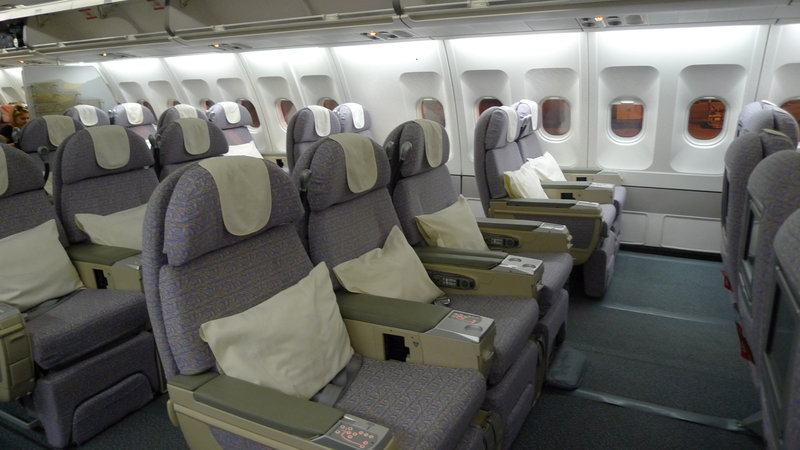
class cabin was poor by Emirates’ standards. It was an Airbus A330-200,
with the old-style business class, so dated seats that recline rather
than going fully flat. There was also very little division between you
and the neighbouring seat, other than a slightly extended armrest.
On a long haul business class flight with an airline of Emirate’s pedigree, this was a disappointment.

The in-flight food was acceptable without being exceptional. A key
difference between Emirates and Etihad (see below) is your ability to
order your food at will with Etihad (i.e. whatever meal is on offer, and
there are a range of choices, can be had whenever you want it, not when
it’s served). Impressively, this is also supplemented by a permanently
available selection of hot and cold snacks. Emirates sticks to a more
limited and rigidly-timed format (you eat when they’re ready, not when
you are).
The in-flight entertainment in the older Emirates cabin was also
mediocre. The selection was very good, but the screen was tiny and quite
difficult to watch in the glare of the cabin lights (which stayed on
for the duration of the flight).
Unlike all the other flights, no amenity kits were provided, which surprised me.
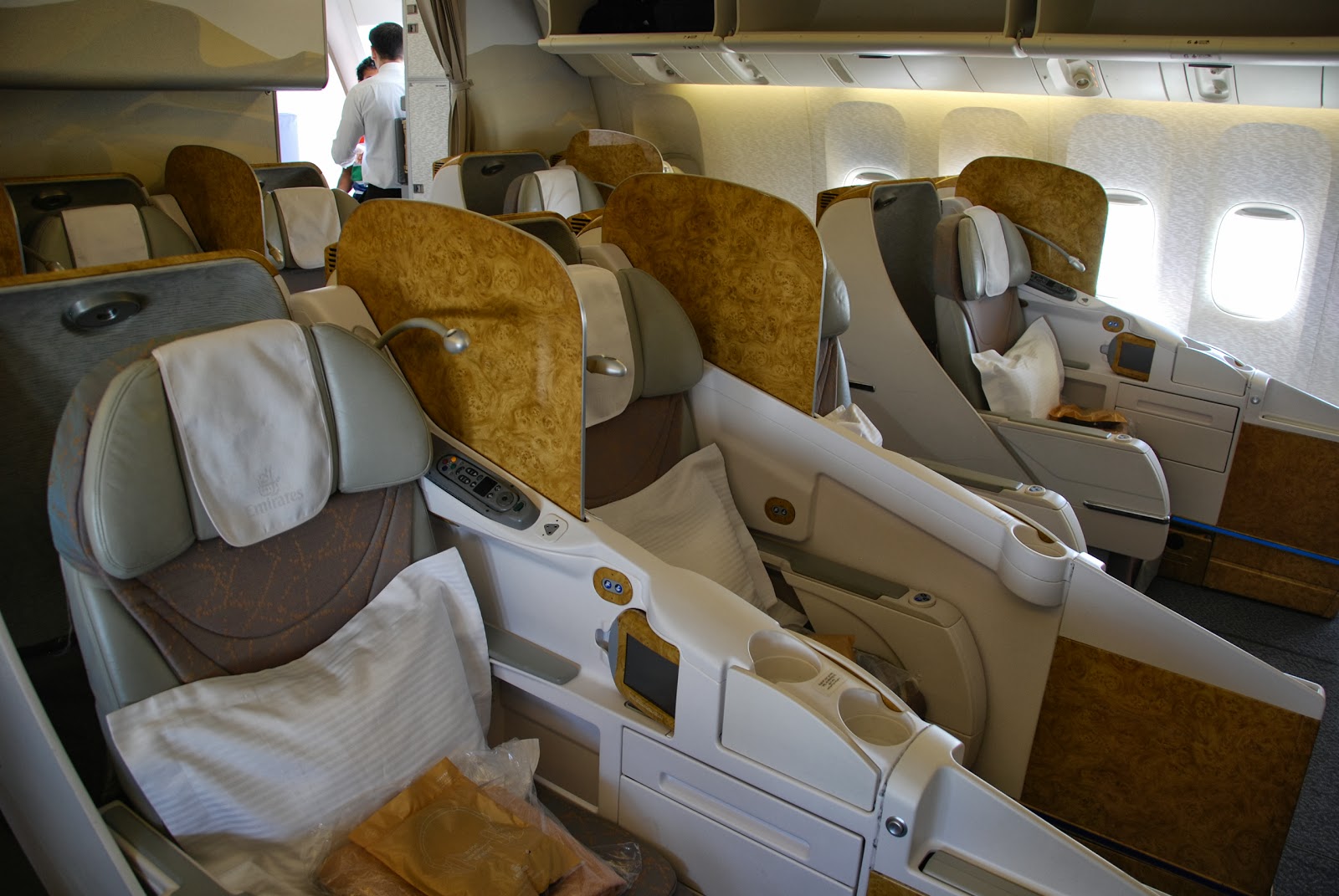
In fairness, the business class cabin from Dubai to Manila (8 hours)
was substantially improved in the Boeing 777-300. It had new, fully
reclining seats, much larger TV screens and a healthy division between
seats. That said, unlike Etihad, the window seats had another seat next
to them, which limits space and privacy somewhat, although there is a
button that brings up a screen between you and your neighbour (should
feeble attempts at polite conversation not be your thing).
In fact, in terms of the cabin itself, there wasn’t a great deal to
distinguish between the Emirates and Etihad Boeing 777 business classes,
although I would say that the Etihad product is superior (and the
Etihad business class in the Airbus 330 is frankly to be avoided).
Principally, however, it was the in-flight service and the lounges that
made Etihad the runaway winner.
The lounge
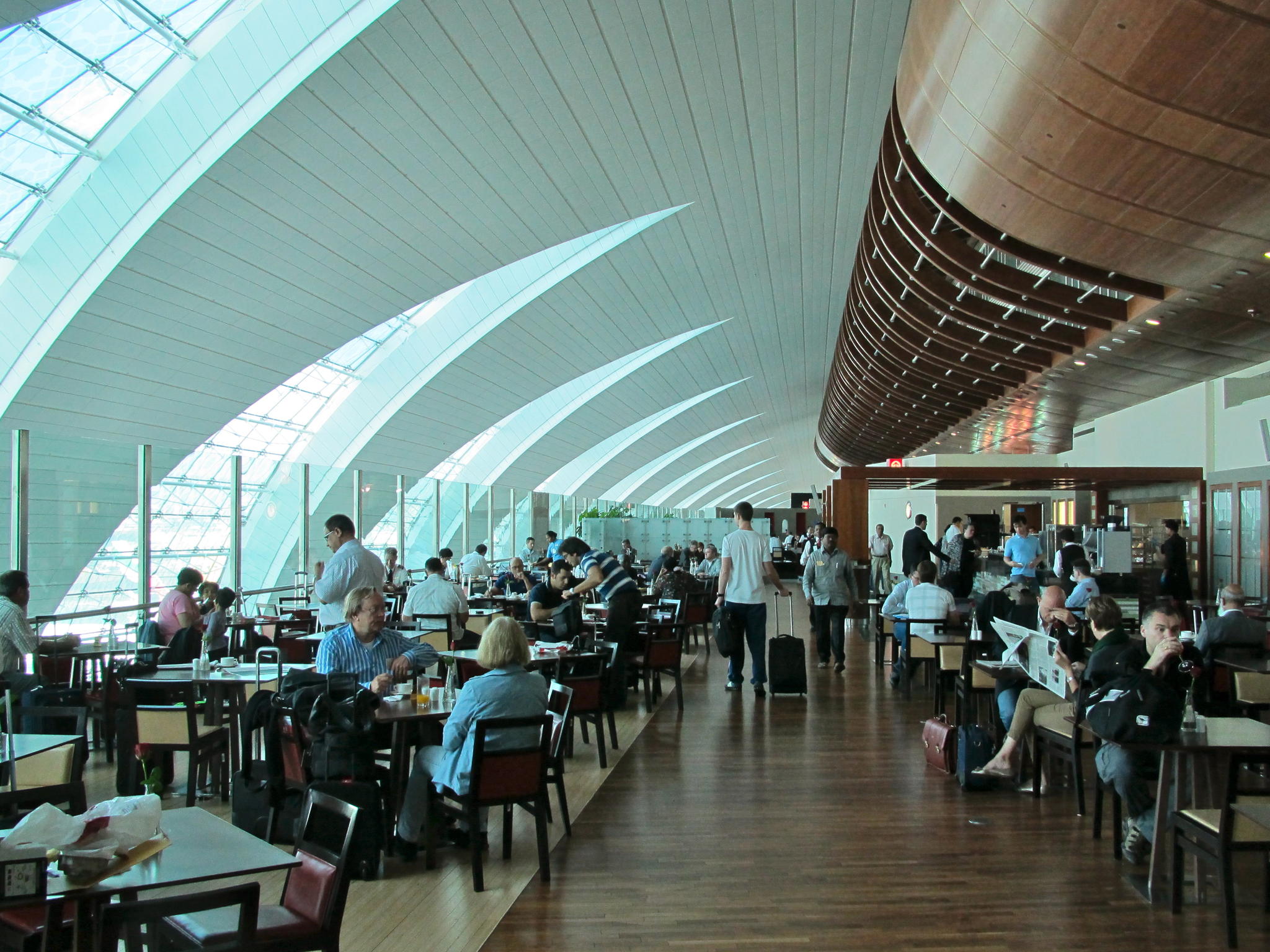
The Emirates business class lounge in Dubai is huge. While there was a
good spread of food and drink, the sheer size and number of people in
it made it feel rather more like a well-appointed staff canteen than a
premium lounge.
I do appreciate that Emirates needs to cater for business travellers
on a fairly industrial scale in Dubai, but there’s little doubt that
this very much leads to a loss of the “premium feel” that these lounges
should provide. As a result, there was very little attention from staff,
and there did not seem to be any a la carte dining options, it was all
down to the buffet.
Notably, and in stark contrast to Emirates, Etihad managed to strike a
near perfect balance between catering for the (relative) masses, while
maintaining an air of luxury to their business lounge in Abu Dhabi.
The trip back in Etihad business class
The flight
Returning, the Etihad experience was absolutely fantastic (Sydney to
Abu Dhabi, and then on to London). You are lavished with attention (and
food… and drink…) when you fly business class with Etihad.
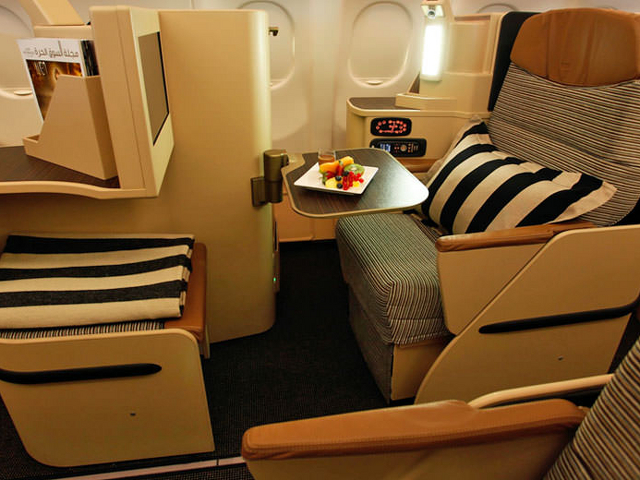
The Etihad Boeing 777 business class seats are excellent: your own
little private pod, with an array of extras including a massage function
(also on Emirates 777s), a well-sized TV screen and a range of TV and
audio options. There is, of course, a fully reclining seat.
Putting the Etihad lounge superiority to one side (see below), there
were two real stand-out elements to the Etihad 777 business class
service cabin versus Emirates. The first was the individual seats next
to the window, which were fantastic. Your nearest neighbour is an aisle
away, giving you real privacy and comfort.
Second, the in-flight service is of the very highest quality. As
noted above, the meals are served off a menu, and while your order is
taken early, it’s then up to you when you actually want to have the food
delivered. On a 14 hour overnight flight, this is great: gone are the
concerns with eating the wrong meal at the wrong time, or waking up
halfway through a sleep for a three-course meal – it’s all in your
hands.
Beyond that, a limited a la carte menu provides constant access to a range of hot and cold snacks.
I can categorically say that Etihad long-haul business class exceeded all expectations.
The lounge
Etihad’s impressive hospitality is well reflected in its lounges. I
began in the well-appointed if modestly sized lounge at Sydney airport,
with a three course meal. While the portions were small, the food was
great.
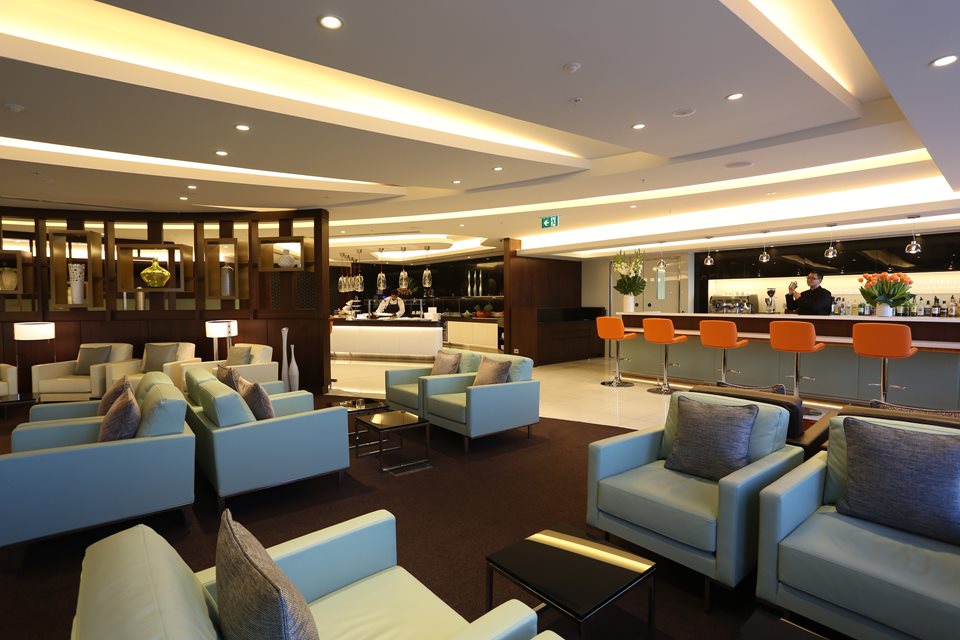
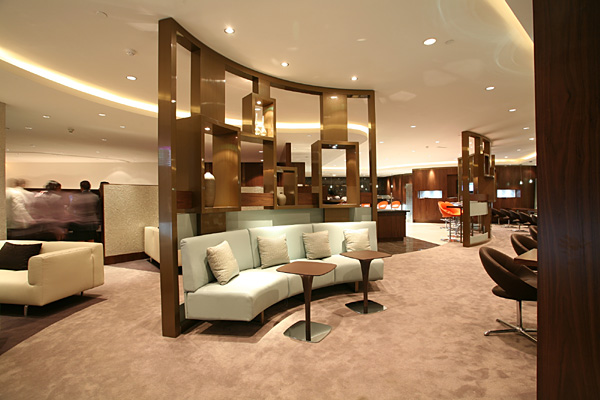
The Etihad business class lounge in Abu Dhabi is on the same scale as
the Emirates lounge in Abu Dhabi, but remains absolutely fantastic.
Given its size, it could easily suffer from the same issues as Emirates’
Dubai offering. However, it manages to maintain a premium feel despite
its expanse.
This is helped in part by the a la carte dining, and free-to-use spa
(where I had a 15 minute head and shoulders massage: much needed after a
14 hour flight).
My only criticism, and it’s a fairly fundamental one, is the
comically limited bathroom facilities. I won’t go into too much detail
here, but suffice to say, be prepared to queue. At peak times, showers
will be particularly hard to come by, and this is something that does
need to be addressed.
And the winner is…
Well, you may
just about have picked up from the title and
tone of this post that Etihad provided a substantially more impressive
business class service.
In fairness, the Emirates flight from Dubai to Manila was perfectly
acceptable, without going above and beyond what one might expect from
business class. The first flight, however, was poor.
Etihad’s supremacy is down to a consistently high quality business
class cabin, superb premium lounges, and the kind of in-flight attention
that goes some way to justifying the cost of business class travel. I
very much look forward to flying with them again.
Conclusions?
If I am ever faced with the option of similarly priced and similarly
convenient business class flights with Etihad or Emirates again, there’s
no doubt that I would make the whole journey with Etihad.
This is how business travel at its best should be – expectations exceeded in every way.



 – Skift